The change in African mine ownership affects how companies sell to the industry. Africa Mining IQ helps sellers navigate this shifting landscape by showing who owns what, who actually approves, and when to engage. With ownership intelligence, project-by-phase filters, and nearly 10 000 verified decision‑maker contacts, subscribers can target the right corridors, tailor proposals to owner expectations (site‑speed vs. governance), and time outreach to milestones that matter. Real‑time alerts and plain‑language briefs turn noise into next steps, so your offer lands relevant, on time, and ready to be approved.
Who owns the largest share of African mines?
Ownership is shifting locally, with more approvals made on site, not in overseas boardrooms.
What is the significance of the shift toward minerals needed for the global energy transition?
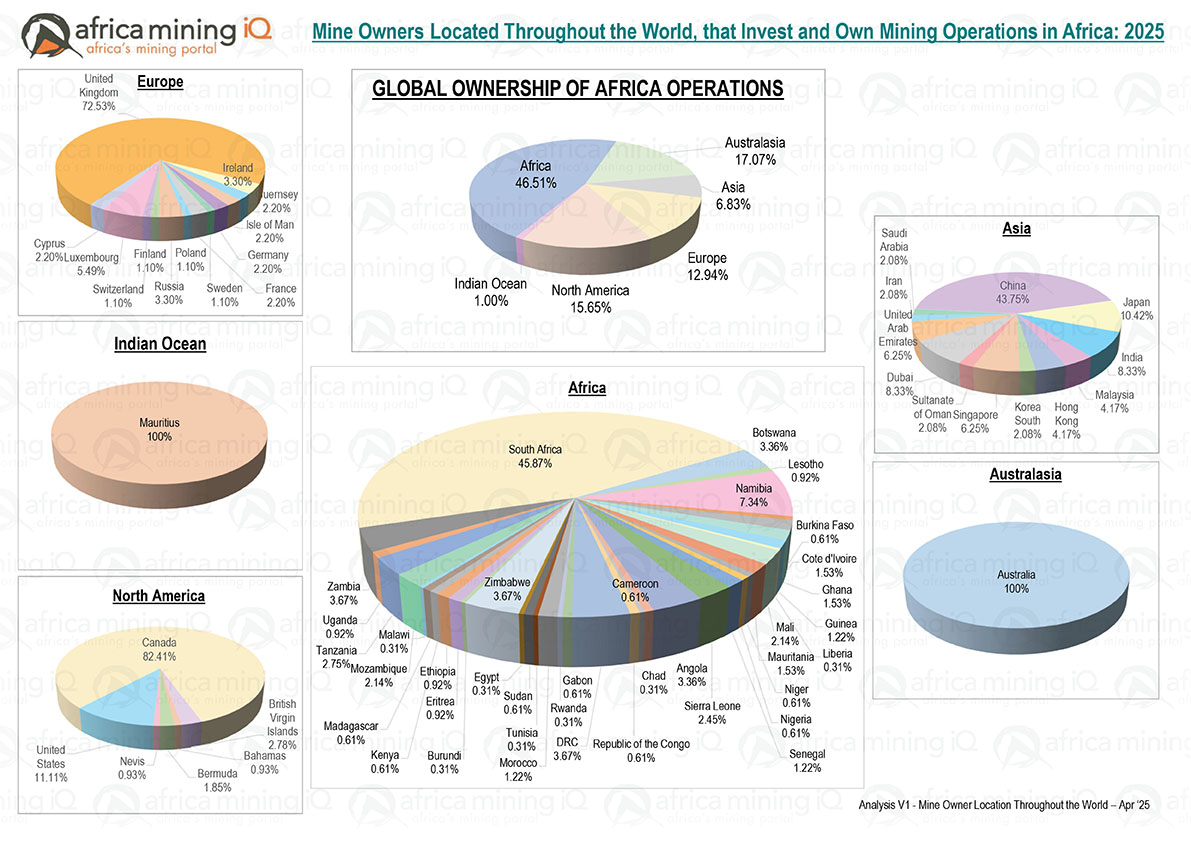
- Africa-based owners: ~47% (largest share)
- Australasia: ~17%
- North America: 16%
- Europe: 13%
- Asia: 7%
- Indian Ocean territories: ~1%
- Decision locus: in-country—COOs, Mine Managers, Procurement Heads
These changes affect approvals that hinge on uptime, response speed, and local capability as much as price.
Which countries are the major hubs for mining ownership in Africa?
South Africa anchors overall activity and spend, with steady demand for modernisation and maintenance. Zambia and the DRC are pivotal for cobalt, cobalt efficiency and power-stability projects. In West Africa, Ghana, Mali, and Mauritania are strongholds for modular gold and base-metal developments. Namibia and Botswana stand out for compliance-driven environments with rigorous permitting and safety expectations.
Why the United Kingdom is so prominent in European ownership?
The UK represents the dominant share of Europe’s footprint. UK-governed assets are expected to deliver lifecycle value on paper from day one, with documented ROI, safety certifications, and ESG reporting, often paired with structured, multi-year maintenance frameworks. Practical takeaway: Show an audit-ready pack early to avoid being parked in procurement.
What factors are behind the rise of Asian ownership?
Asia’s slice, led by China, has edged up due to integrated solution models (equipment plus services), vendor financing, and assured logistics/commissioning. Winning offers typically include end-to-end packages, firm delivery commitments (about 12-16 weeks), and embedded commissioning teams for the first 90 days.
What do these shifts in ownership mean for Africa?
Decision power moving in-country prioritises service quality, local skills, and fast recovery from downtime. At the same time, global investors (UK, Canada, Asia) still enforce rigorous governance. Sellers must run two lanes in parallel: site execution that proves uptime and responsiveness, and parent-company compliance that proves ROI, safety, and ESG.
Do these figures reflect production or revenue?
No, the figures speak to ownership and decision influence, not production tonnage or revenue. For go-to-market planning, ownership and project phase are the critical filters; production is useful, but it won’t tell you who signs or which standards you must satisfy.
Who owns mines in South Africa?
Ownership is mixed, local companies/state entities alongside international owners, but buyer behaviour is consistent: reliability over novelty, predictable shutdowns, and high expectations for response and parts availability. What wins: boots and spares in-country, a real 48-72-hour SLA, and upgrades that fit shutdown windows.
Which country has the most mines in Africa?
South Africa leads on overall project activity. Beyond that, concentrate where your solution fits the operating reality: copper-cobalt corridors in Zambia/DRC for throughput and energy savings; West Africa for fast-moving, modular packages; Namibia/Botswana for compliance-led deployments.
Who owns the gold mines in Africa?
Gold ownership is mixed across African-based owners and international groups (notably UK/Canada/Australia and China-aligned entities), with strong clusters in Ghana, Mali, and Mauritania, plus parts of Southern and East Africa. How to approach: tailor to the owner profile, governance-heavy documentation for UK/Canada-led assets; integrated, finance-enabled offers for China-backed projects; service-speed-first for African-based owners.
How AMIQ helps you act on this intelligence
- Ownership and influence: See who owns what, how parent ties shape procurement, and who actually signs or influences approvals.
- Live pipeline: Filter 2 000+ active projects by country, corridor, commodity, owner, and phase to meet buyers at the right moment.
- Real decision-makers: Access nearly 10 000 verified contacts, COOs, mine managers, procurement heads, EPC engineers.
- Timing and alerts: Get notified when projects shift phase, permits move, funding lands, or leadership changes, so you position pilots, spares, and SLAs before tenders go wide.
- Clear, shareable intel: Plain-language briefs with source trails and exportable packs for internal alignment.
What’s the bottom line?
Match your proposal to the country context and the owner’s governance style, and time it to the project phase. With AMIQ, you can shortlist the right projects, reach the real decision-makers, and deliver a two-lane proposal, fast site execution, plus parent-level proof, that moves deals from “sounds good” to “approved.”
Listen to our latest podcast here.